








TL;DR
- Mortgage spreadsheets are costing brokers 10+ hours per week
- Hidden cost: £3,000+ monthly productivity loss
- Major risk: weak audit trails for compliance
- Manual workflows create errors and delays
- Modern systems improve speed, accuracy, and scalability
- Tools like myCriteria and Spently streamline mortgage workflows
Introduction
Spreadsheets have long been a trusted tool for UK mortgage brokers.
But in 2026, the real issue isn't whether they work—it's how much they're quietly costing your business.
With increasing:
- Regulatory pressure
- Client expectations
- Workflow complexity
Spreadsheets are starting to show their limits.
This article breaks down:
- The risks and inefficiencies of mortgage spreadsheets
- The hidden financial cost
- Where brokers lose time
- And what smarter alternatives look like
The Changing Landscape of Mortgage Workflows
Mortgage broking is becoming more structured, faster, and compliance-driven.
Key trends:
- More complex borrower scenarios
- Increased need for auditability and transparency
- Pressure for faster turnaround times
- Adoption of AI-driven systems
📊 Industry Insight
- The Financial Conduct Authority emphasizes suitability, accuracy, and auditability
- Brokers spend 30-50% of time on admin tasks
The shift:
Efficiency + compliance are now non-negotiable.
What Types of Mortgage Tools Exist Today?
Manual Spreadsheet-Based Systems
Strengths
- Flexible
- Familiar
- Low cost
Limitations
- Manual data entry
- Error-prone
- No automation
Semi-Digital Tools
Strengths
- Better organization
- Some efficiency gains
Limitations
- Still manual-heavy
- Fragmented systems
AI-Assisted Mortgage Systems
Strengths
- Real-time processing
- Automated matching
- Scalable workflows
Limitations
- Requires onboarding
- Needs alignment
Strengths Brokers Commonly Appreciate
- Flexibility
- Centralized tracking
- Low setup barrier
Recurring Limitations & Friction Points
- Time-consuming updates
- Lack of integrations
- Version control issues
- No intelligent recommendations
Critical Compliance Gap
Manual spreadsheets make it nearly impossible to provide a consistent, auditable trail for FCA Consumer Duty compliance, leaving your firm vulnerable during regulatory reviews.
The Invisible Cost of Mortgage Spreadsheets
This is where most brokers underestimate the impact.
- £500 per case
- ~3 hours admin per case
- v £166 lost per case
Monthly impact:
- 20 cases → £3,320 lost/month
- Annual → £39,840 lost
Reality check:
You're paying for spreadsheets with your time—and revenue.
A Practical Problem Many Brokers Encounter
The “Criteria Matching Bottleneck”
- Multiple lenders
- Changing criteria
- Manual comparisons
Result:
- Delays
- Errors
- Reduced client experience
Mini Case Study: Real Broker Impact
UK broker using spreadsheets:
Before
- 2-3 hours per case
- Manual comparisons
- Slow turnaround
After workflow improvement
- 60% faster processing
- Better accuracy
- Increased client satisfaction
Insight:
The inefficiency was in the process—not the broker.
What Brokers Often Need But Struggle to Find
- Real-time criteria updates
- Faster processing
- Reduced admin
- Clear audit trails
How Modern Systems Address These Gaps
Example: Intelligent Criteria Matching
- Instant lender matching
- Reduced manual effort
Example: Automated Data Structuring
- Capture once, reuse everywhere
- Eliminate duplication
Example: Workflow Optimization
- Faster case progression
- Reduced bottlenecks
Feature Spotlight: How Modern Systems Work
Modern systems use:
- Structured data
- Rule-based logic
- Automated updates
Result:
- Faster decisions
- Better accuracy
- Improved compliance
Product Insight: From Spreadsheet to Smart Workflow
Where myCriteria & Spently Fit
- myCriteria → simplifies lender matching
- Spently → streamlines workflows
Both are part of the Mortgage AI Toolkit ecosystem, designed to replace manual inefficiencies with structured processes.
Trusted by UK Mortgage Professionals
“WIS mortgage advisers consistently report that they underestimated the time lost to spreadsheets until they moved to a more structured workflow. The resulting speed improvement has significantly changed how they manage client cases.”
How to Choose Mortgage Tools: Key Questions to Ask
- Does it reduce manual work?
- Can it handle complex cases?
- Does it support compliance?
- Is it scalable?
Practical Considerations
- Integration
- Usability
- Scalability
- Data accuracy
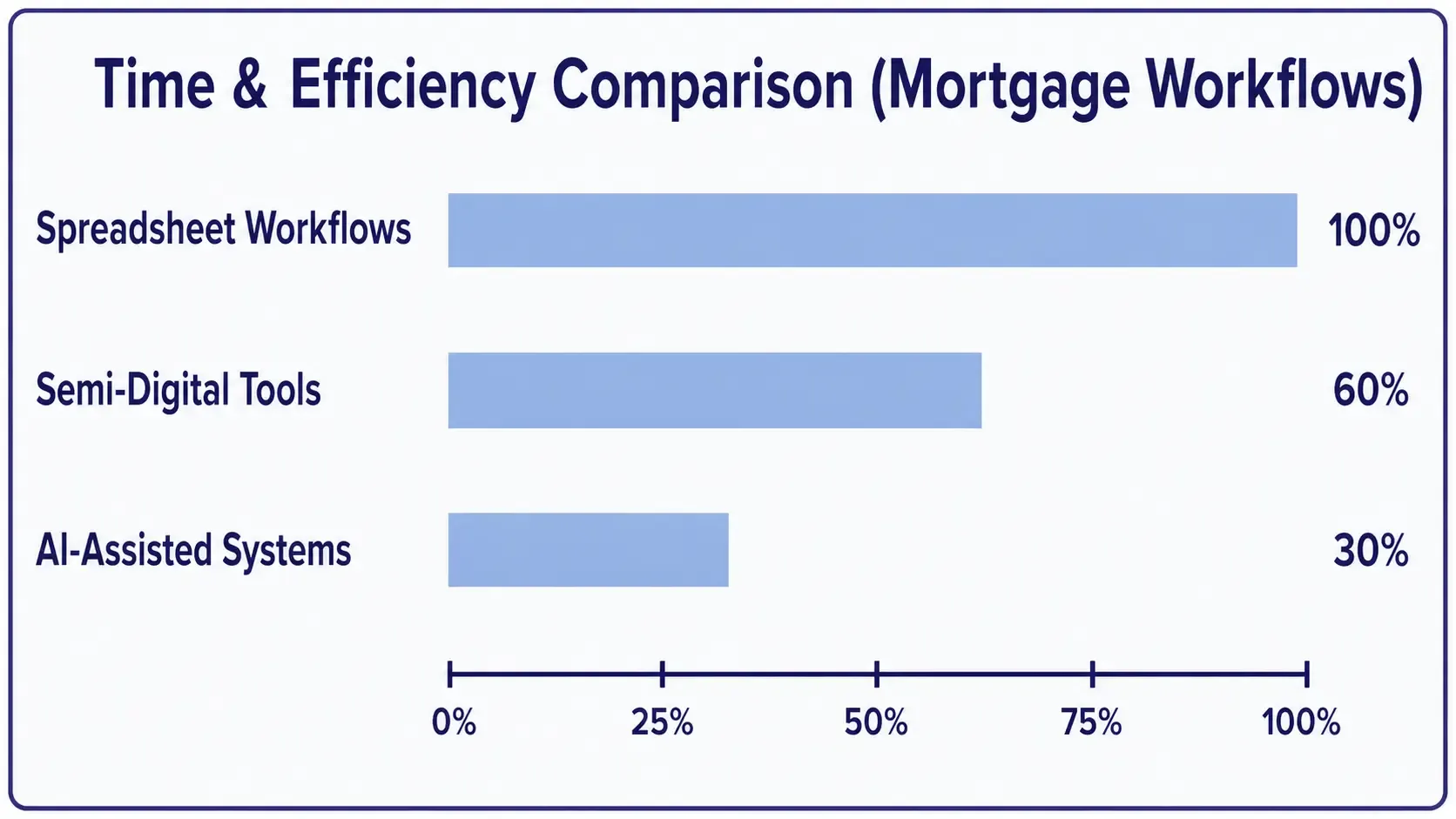
Comparison: Spreadsheet vs Modern Systems
Key Takeaways for Brokers
- Spreadsheets limit efficiency and compliance readiness
- Hidden cost = lost revenue
- Modern systems improve speed and accuracy
- Biggest gain comes from eliminating repetitive work
Conclusion
Mortgage spreadsheets aren't broken—but they're no longer enough.
As the industry evolves, brokers who:
- Reduce manual workload
- Improve workflows
- Adopt smarter systems
Will outperform those who don't.
👉 The real question is:
How much are your spreadsheets costing you every month?
FAQs (SEO Optimized)
1. Are mortgage spreadsheets still useful?
Yes, but they are increasingly inefficient for modern workflows.
2. How much do spreadsheets cost UK mortgage brokers?
Research suggests manual admin costs brokers approximately 10 hours and £3,000+ in potential revenue per month, depending on case volume.
3. What is the biggest risk of using spreadsheets?
Errors, inefficiencies, and lack of auditability for compliance.
4. Can modern tools replace spreadsheets?
They enhance workflows and reduce reliance on manual processes.
5. What is the first step to improving efficiency?
Identify where your current workflow is losing time.